
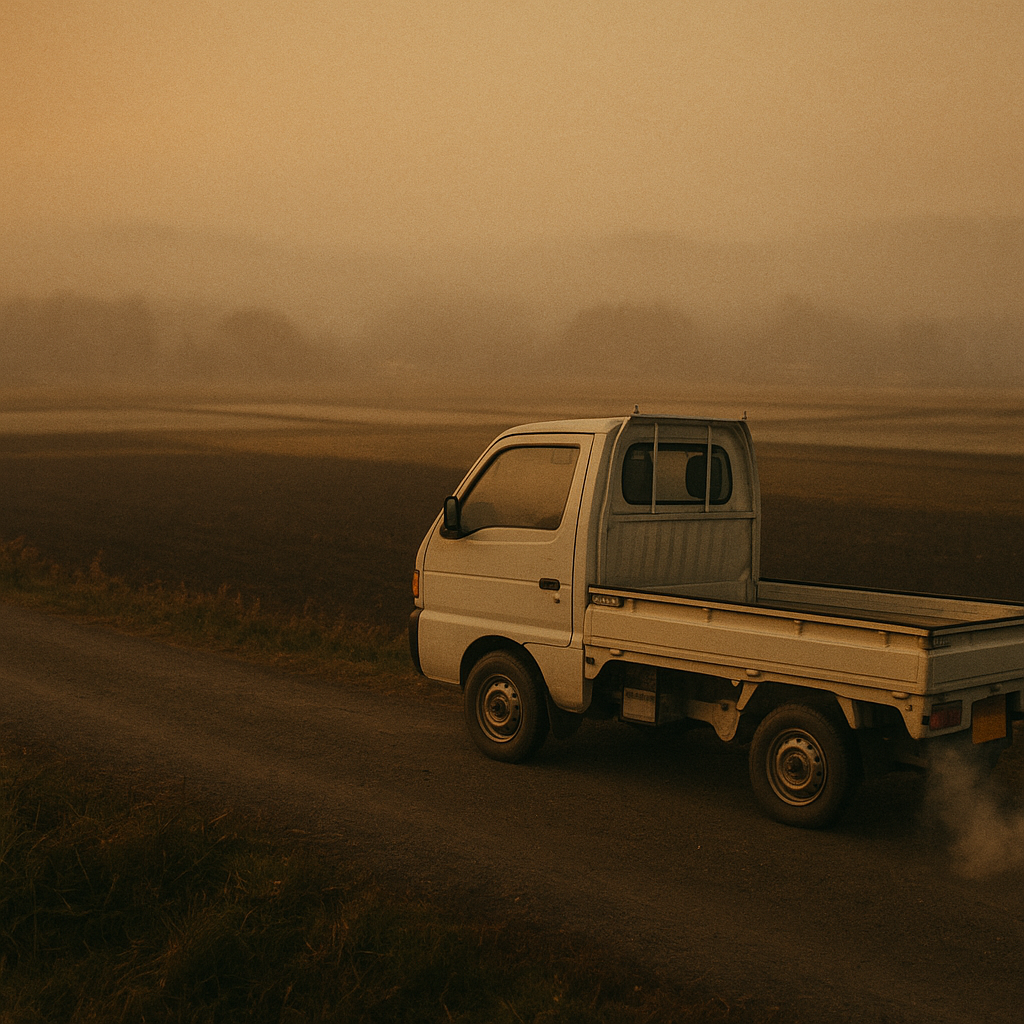
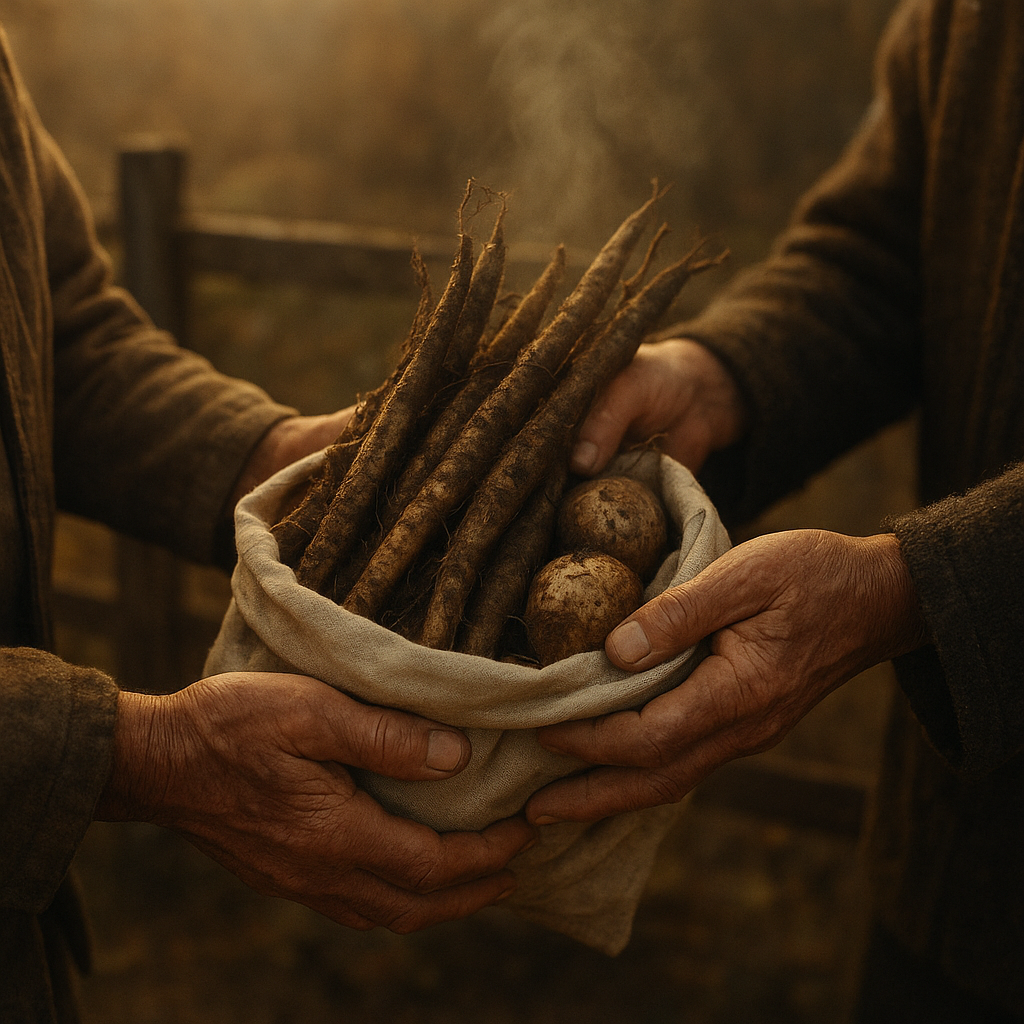
A light truck was parked on a rural road at five in the morning, its engine still running, sending white exhaust into the cold air. The truck bed was filled with muddy burdock and taro, covered by a damp burlap sack. I stood beside it, saying nothing. I couldn’t find the words, or rather, there was no need to speak.
This was the outskirts of Hanamaki City in Iwate Prefecture, where rice fields and farms stretched along a tributary of the Kitakami River. I had come to this place to meet a chef who runs a small eatery in Hanamaki. The restaurant has twelve seats, six at the counter, and two small tables. It’s open only for lunch and dinner, and reservations are taken by phone only. There’s no website. The menu is handwritten on a chalkboard and changes daily.
I first heard about this restaurant at an izakaya in Morioka City. An older man sitting next to me, while sipping beer, began to talk about a unique eatery in Hanamaki. By “unique,” he didn’t mean the dishes were extravagant. He meant, “The chef sources his own ingredients.” Instead of going through suppliers, he visits farmers directly to see what is available that morning before deciding on the lunch menu. That was the story.
The next morning, I headed to Hanamaki.
The chef, whom I will refer to as Mr. K for this narrative, is in his mid-forties, short in stature, with large hands. When I first saw him working in the kitchen, his movements were strangely quiet. It wasn’t just that he was efficient; it felt as if he was contemplating each action.
Mr. K sources from several farms. One is located in the Tōwa district of Hanamaki, another in the Ishitoriya district, and a third near Kitakami City. Each farm specializes in different produce. The Tōwa farm focuses on root vegetables, Ishitoriya on leafy greens and herbs, and the Kitakami farm deals with mushrooms and wild vegetables. Mr. K combines these to determine the day’s menu.
“It would be easier to buy from suppliers,” Mr. K said. “But the vegetables from suppliers are already sorted. You won’t get any with blemishes or those that don’t meet standards. Yet, sometimes the blemished ones taste better. The irregular ones can have a stronger aroma.”
As I listened, I sipped coffee made with water boiled in an old electric kettle in the corner of Mr. K’s kitchen. It was weak but warm. Outside, it was still dark.
“When you visit a farmer, you can gauge their condition,” Mr. K continued. “If the weather has been bad this year or if they’ve been struggling with back pain and couldn’t manage their crops well. These things show on the vegetables. Knowing this changes how you cook.”
I was intrigued by Mr. K’s choice of words, particularly his use of “changes how you cook.” He didn’t assert it as a fact. Even if he was confident, he refrained from making absolute statements. I couldn’t tell if this caution stemmed from his integrity as a chef or a humility born from years of experience.
The next morning, I accompanied Mr. K on his sourcing trip. We set off at five o’clock, and I was still sleepy. The mornings in Hanamaki in November are bone-chilling. When I got into the passenger seat of Mr. K’s truck, the heater hadn’t warmed up yet.
We arrived at the Tōwa farm shortly after five-thirty. The farmer, a man in his sixties, was already dressed in work clothes, standing at the edge of the field. They exchanged no particular greetings and simply peered into the truck bed together. Burdock, taro, and a few bunches of thin turnips were there.
“How are today’s turnips?” Mr. K asked.
“They got a bit sweeter from yesterday’s frost,” the farmer replied.
That was all. They hardly discussed prices. Later, I learned that the general rates had been established over years of acquaintance, and they didn’t engage in detailed negotiations. “If you negotiate, the relationship changes,” Mr. K said. “Once it becomes a business relationship, good vegetables stop coming. It’s a strange thing.”
Having worked in trade for a long time, I understood well how price negotiations can alter relationships. However, I had seldom encountered someone who spoke of this in the context of sourcing ingredients. Perhaps I simply didn’t remember. My memory tends to fail me when I’m tired.
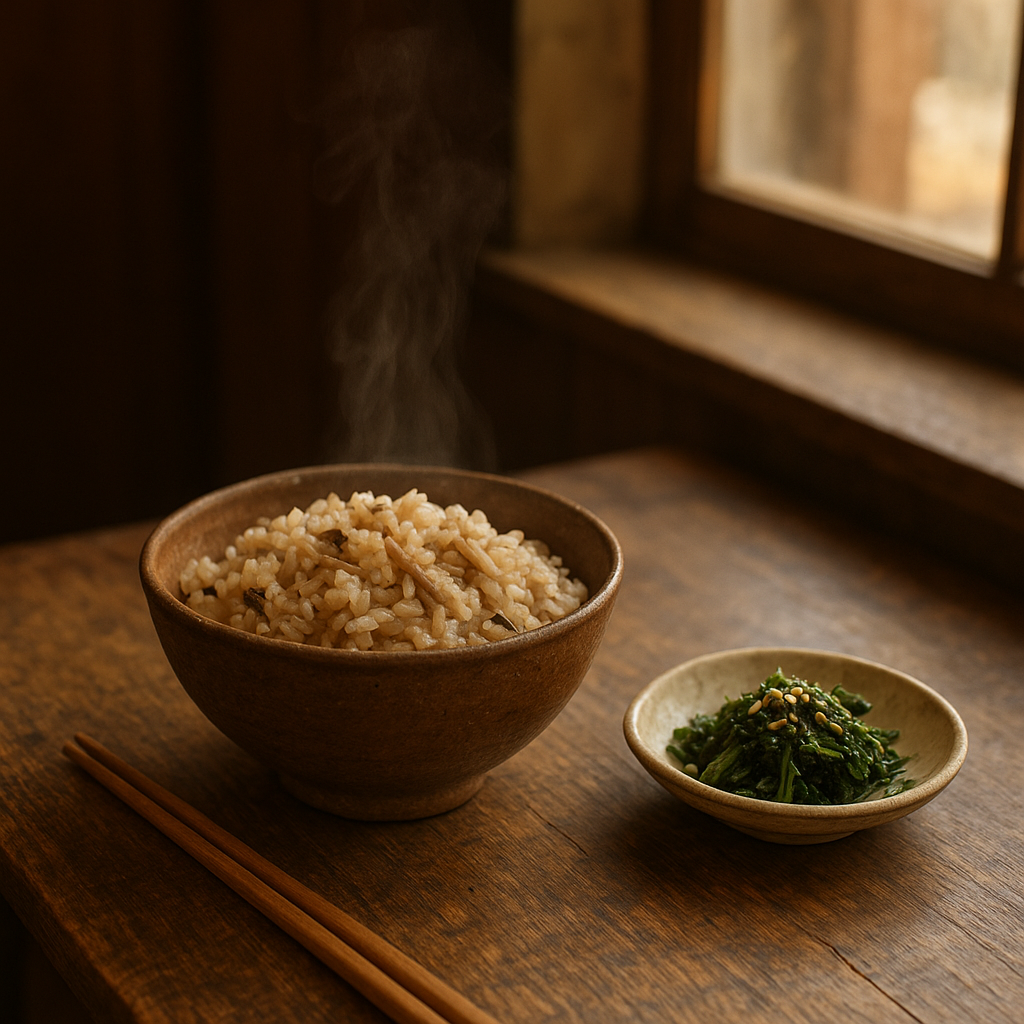
Before lunch service began, Mr. K stood in front of the chalkboard, holding a piece of chalk, contemplating for a moment. Today’s menu included burdock rice, taro miso soup, thinly sliced pickled turnips, and a small dish made with spring greens from Ishitoriya that he had sourced yesterday. That was it.
“That’s a small menu,” I remarked.
“If I make it larger, people won’t eat it all,” Mr. K replied. “Customers don’t come to decide what to eat. They come to enjoy what’s in season in Hanamaki today. So, there’s no need for a large menu.”
I felt as though I had heard this perspective somewhere before, but I couldn’t recall where. Was it from someone in North America or Southeast Asia? In my trade work, I often encountered people with similar philosophies, speaking different languages. Even while discussing ingredients, it felt like I was listening to their life stories. I still occasionally ponder what that was about.
By noon, nearly all twelve seats were filled. There were many older women, but a young couple with a child was also present. The child slurped the taro miso soup noisily. Mr. K chuckled at the sound, and I found myself smiling too.
The Ishitoriya spring greens had not been grown in the area for long. Before Ishitoriya merged with Hanamaki, it was known for its sake-brewing culture. Although spring greens had not been cultivated there for long, Mr. K began sourcing from a farmer who started growing them about ten years ago.
Mr. K met this farmer at a morning market in Morioka City. “There was an old man selling strange spring greens,” Mr. K recalled. “By ‘strange,’ I mean they had an overpowering aroma—about three times stronger than regular spring greens. They weren’t selling well, so I bought them all.”
“All of them?” I asked.
“Yes. When I asked where they were grown, he said Ishitoriya. That’s how our relationship began.”
The strong aroma of the spring greens is largely due to the timing of the harvest and the amount of fertilizer used. This farmer picks them slightly later than the usual harvest time, which enhances their fragrance. While they would be considered substandard for the market, Mr. K gladly accepts them.
I tasted the small dish of spring greens, prepared with sesame. The aroma of the greens came through slowly in my mouth, spreading to the back of my nose a few seconds after I chewed. That delay felt intentional. When I asked Mr. K about it, he said, “The oil from the sesame delays the release of the aroma a bit. I like that, which is why I combine them this way.”
There was intention behind it. Naturally, confirming this added a certain weight to the dish.
Building relationships with farmers takes time. Mr. K began working with his first farmer before opening this eatery, when he was employed at another restaurant in Morioka. He had developed the habit of visiting farmers personally back then.
“At first, they found me bothersome,” Mr. K said. “If you suddenly show up and ask to buy vegetables, farmers are confused. They don’t know the quantity, the frequency, or whether they can trust you. I was often turned away.”
A turning point came when he helped out with a farmer’s harvest. It wasn’t a request; he simply offered his help when he saw they were short-handed. That small act changed their relationship. “We started talking about vegetables—how they grow them, what challenges they faced that year. I could finally have those conversations.”
Mr. K explained that sourcing is not merely the act of buying vegetables; it’s about maintaining relationships. Within those relationships lies the quality of the ingredients. Conversely, if the relationship falters, the quality changes. The moment you try to lower the price, something shifts.
As I listened to his story, I recalled several past business dealings. There were similarities between the successful ones and those that didn’t go well, echoing Mr. K’s insights. While sourcing ingredients and international trade are different, I felt there’s a fundamental essence in the act of exchanging goods between people that resonates across contexts. I can only express it as a feeling.
Mr. K’s eatery has no menu—just a chalkboard. He writes on the board every morning after returning from sourcing. Sometimes he realizes he doesn’t have enough ingredients and erases what he wrote. Items can run out during lunch service.
“Don’t customers get angry?” I asked.
“Regulars don’t get upset. First-timers sometimes look puzzled. But when I explain, they generally understand.”
When I asked what he explains, he said, “I just tell them where today’s ingredients came from. I say, ‘This burdock is from Tōwa in Hanamaki, harvested this morning.’ That’s usually enough.”
I pondered where this sense of “understanding” comes from. It’s not a simple matter of stating the origin. It’s about the realization that what you’re eating was born here today. It’s the sense that food is not an abstract product but has a specific time and place. When that realization is present, running out of items becomes more acceptable.
When discussing local production for local consumption in Iwate, I often feel a bit weary when the conversation starts with “Nanbu ironware” and “wanko soba.” While those are important, the culture embedded in the act of running down a rural road to receive muddy vegetables every morning, as seen in Mr. K’s eatery, is more understated and sustainable. It doesn’t make it into tourist brochures, yet I believe it represents the essence of regional food culture.
One of Mr. K’s suppliers, a farmer near Kitakami, specializes in mushrooms and wild vegetables. The farmer is a woman in her seventies who has been managing the farm alone since her husband passed away a few years ago. The scale isn’t large.
When I visited her farm, I noticed dried persimmons hanging at the entrance. Dozens were strung together with thin twine, creating a nostalgic yet slightly different image from my memories.
The farmer spoke about her relationship with Mr. K. “He values the ingredients. When you give them to someone who appreciates them, it makes the effort worthwhile.”
She didn’t elaborate further. She served tea, and we sat quietly for a while, gazing at the hanging persimmons. The wind outside gently swayed the twine.
I thought about how food culture is built through moments like this—not through recipes, cooking methods, or information about ingredient origins, but through the accumulation of quiet moments shared over tea beneath the sway of dried persimmons.
As a side note, I once spent a long time in Vancouver for trade work. There was a neighborhood in the city where many Japanese restaurants were clustered. I visited one of them several times, a ramen shop.
It was delicious, but something felt off. It wasn’t the temperature of the soup; it was about the ingredients. The noodles were made by a local noodle shop, founded by someone who had learned the craft in Japan and was originally from Tokyo. The pork for the chashu came from a farm in British Columbia, and the soy sauce was from a Canadian-Japanese manufacturer.
When Japanese food crosses the ocean, the ingredients change. When the ingredients change, the flavors change. Those altered flavors become the local version of “Japanese food.” That’s not necessarily a bad thing, but it’s no longer the local food culture of Japan; it’s Vancouver’s food culture. When trying to evaluate the regions of Japan from that perspective, something gets lost. When evaluated while still out of sync, regional chefs, especially those like Mr. K, are left bewildered.
Mr. K’s dishes come from the soil, water, and farmers of Hanamaki. Measuring them against the context of Vancouver is impossible.
While observing the evening service at Mr. K’s eatery, a customer pointed to the chalkboard and asked, “Where is this turnip from?” Mr. K replied, “It’s from Tōwa in Hanamaki, harvested this morning.” The customer nodded slightly and said, “Ah.” There was something in that “ah”—a mix of relief, understanding, and something else.
Hearing that “ah,” I contemplated the true meaning of local production for local consumption. It’s not just about the distribution of ingredients; it’s an act of confirming one’s own footing. It’s the act of verifying that what you’re eating was born here today. That connects the chalkboard of the eatery, the rural road truck, and the sway of dried persimmons with a single thread.
I asked Mr. K about his future plans. Did he want to expand the restaurant?
“No,” he replied immediately. “If I expand, the way I source will change. If that changes, I won’t be able to make the dishes I do now.”
That was all. I had no response to that answer. There was no need to respond.
On the morning I accompanied him on his sourcing trip, I dozed off in the passenger seat of the truck. On the road to Ishitoriya, amidst the engine’s vibrations and the dim light, I found myself closing my eyes.
When I woke up, it was a bit brighter outside. I could see the mist over the Kitakami River beyond the rice fields. Mr. K said nothing. I said nothing.
As we arrived at the spring greens farm and watched the bags being loaded onto the truck bed, I kept trying to recall something. I felt as though I had seen a similar morning scene somewhere before. It wasn’t in Iwate. Perhaps further south or in another part of Tōhoku. My memory was elusive.
In the end, I couldn’t remember.
This has been happening to me more frequently lately. Perhaps I’m tired. Or maybe too many similar mornings have piled up, making it hard to distinguish one from another.
Yet, I still vividly remember the cold air of that morning, the aroma of the spring greens, and the way Mr. K’s large hands received the bags. Memory is uneven. There’s no logic between what fades and what remains.
The term “local production for local consumption” is now widely used. It appears in pamphlets from the Ministry of Agriculture, Forestry and Fisheries, on signs at roadside stations, and on menus at high-end restaurants in Tokyo. As the term spreads, it feels as though it’s losing weight.
What Mr. K does can be described by the term “local production for local consumption,” but there are aspects that cannot be fully explained. The act of accepting vegetables from a year when the farmer had back pain, helping with the harvest, and sharing quiet moments over tea beneath the sway of dried persimmons—these are not merely techniques of sourcing.
It’s about relationships. It’s a bond cultivated over many years between two specific individuals. It’s not something anyone else can replicate or systematize.
That’s why Mr. K’s dishes can only be made by him. The burdock from Tōwa in Hanamaki, the spring greens from Ishitoriya, and the mushrooms from the farm near Kitakami come together on today’s table in Hanamaki. It’s something unique to today. Tomorrow will be slightly different. Next year may be even more so. When the farmers change, the vegetables change. When the vegetables change, the dishes change.
Mr. K doesn’t seem afraid of that change.
